Pokies Parlour Casino in Australia: What It Means
 Available in AU
Contents
A pokies parlour describes a physical gaming area, while licensing, online access and bonus claims require separate scrutiny.
A Parlour Is a Place, Not a Promise
A parlour, in the ordinary physical sense, is a room or defined area within a venue. In a casino, the phrase points towards a place where gaming machines are installed and used—not to a separate kind of casino, nor to a guarantee about what a business offers. The language is less formal than the licensing arrangements behind the venue. A room can have a familiar name; its legal status comes from the jurisdiction that authorises the property.
That distinction matters because “pokies parlour” can sound like the name of a standalone product. In Australia, it is more useful to understand it as a description of a physical setting: a casino gaming area associated with electronic machines. The phrase may also be attached to online material, but the words alone do not establish what lies behind a page or what service it represents. A label is not a venue.
Australian casino gambling has a distinctly local administrative shape. Each casino property operates under a licence issued by the state or territory in which it is located, and the industry is regulated at that level. The national picture, then, is not a single chain of command with every property arranged beneath one central authority. It is a set of jurisdictional arrangements, each attached to a place. The room may be inside a large resort or a city complex; the authority over the property remains local.
Choosing a pokies parlour casino in Australia means weighing the details that are available about each operator. This overview highlights known licensing, deposit and payout information to help frame your options.
1. MrPacho
Payout speed: crypto 30-120 minutes, fiat 24-72 hours · Min. deposit: A$30
MrPacho lists crypto payouts in 30–120 minutes and fiat payouts in 24–72 hours. The minimum deposit is A$30.
2. Golden Pokies
License: Curacao
Golden Pokies lists a Curaçao license. No other operator details are provided here.
3. LuckyVibe
License: Curacao Gaming Control Board OGL/2023/176/0095 (Hollycorn N.V.)
LuckyVibe lists a Curaçao Gaming Control Board license, OGL/2023/176/0095, held by Hollycorn N.V.
4. 7Bit Casino
License: Curacao, operated by Dama N.V.
7Bit Casino lists a Curaçao license and is operated by Dama N.V.
5. WinSpirit Casino
License: Curacao eGaming OGL/2024/923/0383 (Antillephone N.V.) · Min. deposit: A$30
WinSpirit Casino lists a Curaçao eGaming license, OGL/2024/923/0383, held by Antillephone N.V. Its minimum deposit is A$30.
6. Lucky Dreams
License: Curacao · Min. deposit: A$20 (POLi)
Lucky Dreams lists a Curaçao license and a minimum deposit of A$20 when using POLi.
7. Ricky Casino
Payout speed: crypto under 1 hour, PayID 1-3 business days · Min. deposit: A$20 (A$30 to qualify for the bonus)
Ricky Casino lists crypto payouts in under an hour and PayID payouts in 1–3 business days. The minimum deposit is A$20, or A$30 to qualify for the bonus.
8. Playfina Casino
License: Curacao eGaming (Hollycorn N.V., since 2017) · Min. deposit: A$20-30 (depends on the offer)
Playfina Casino lists a Curaçao eGaming license held by Hollycorn N.V. since 2017. Its minimum deposit is A$20–30, depending on the offer.
9. SpinsUp
License: Curacao Gaming Control Board OGL/2023/174/0082 (Dama N.V.)
SpinsUp lists a Curaçao Gaming Control Board license, OGL/2023/174/0082, held by Dama N.V.
10. Kingmaker
Payout speed: crypto ~90 minutes, fiat 1-5 days · Min. deposit: A$30
Kingmaker lists crypto payouts in approximately 90 minutes and fiat payouts in 1–5 days. The minimum deposit is A$30.
A specialist casino review describes Australia as having more than 20 full-scale casinos across all eight states. That is a count attributed to a review, not a timeless definition of the market: properties open, close, change status and sit within different licensing systems. The more durable point is structural. A casino is a licensed property, while a parlour is an area or descriptive term that may be used for part of one. Treating the two words as interchangeable can blur the difference between an institution and a room.
The scale of machine provision offers another way to see the physical character of these spaces. Across Australian casinos, 3,308 gaming machines are recorded as both endorsed on venue licences and installed. The paired conditions matter: the figure is not simply a count of machines mentioned in promotional copy, nor a count of every machine in every sort of venue. It concerns casino installations that have the relevant licence endorsement. Behind that administrative phrasing is a practical reality of floors, rooms and equipment, each governed as part of a licensed property.
The word “pokies” belongs to everyday Australian usage; “gaming machines” is the more official-sounding term. The difference is cultural as much as linguistic. One is the familiar name people give the machines, the other the kind of language used in regulatory and venue records. “Parlour” adds an architectural hint: a bounded interior, somewhere to sit, gather, and spend time. It does not tell much about the conditions of entry, the precise layout, or the rules applying to a particular property. Those details belong to the venue and its jurisdiction, not to the noun.
Major Australian casinos operate around the clock. Entry to a casino is restricted to people aged 18 or over nationwide. These shared features give the physical casino a recognizable framework, though they do not make every property identical. A licensed venue still exists within its own state or territory system, with its own identity and physical arrangement. A common operating pattern is not the same thing as a common national operator.
Access & Safety for Australian Online Casinos
The appeal of the word “parlour” may lie partly in its scale. A casino can sound monumental—an institution, an address, a building with a public profile—while a parlour sounds intimate and contained. Yet the smaller word cannot make the activity separate from the larger system around it. A gaming area inside a casino remains part of the licensed property, and its status follows the venue rather than the atmosphere suggested by its name.
That is the useful boundary: a parlour is a place within a physical setting, not a promise attached to a phrase. It may describe an area in a casino, but it does not itself certify a venue, explain its licensing, or guarantee any particular experience. Plainly, the room is not the licence.
The Bonus Language and the Legal Boundary
A no-deposit bonus sounds like a small exception to the ordinary bargain: an account is opened, a credit appears, and play seems to begin without a payment. A sign-up bonus suggests a similar welcome, while the word “bonus” makes the arrangement sound supplementary rather than central. These phrases are easy to read as descriptions of an available benefit. They are not proof that an offer exists, that its terms are as the headline implies, or that the service may lawfully provide online casino gambling in Australia.
The distinction matters because a promotion can be presented in polished language without changing the legal character of the activity behind it. If a site advertises a pokies parlour sign-up bonus, the wording may borrow the familiar atmosphere of a local venue while referring to an online account. “Parlour” can suggest a room, a door, a place with staff and a physical address. On a screen, it may be no more than branding. The name does not turn a website into a licensed Australian casino, and a bonus label cannot do so either.
Australian law draws a firm line around online casino-style gambling. Under the Interactive Gambling Act 2001, operators may not provide real-money online casino games to people who are physically in Australia. The prohibition covers forms such as slots, poker and table games, not merely a particular promotional format. A no-deposit credit, a sign-up reward or another inducement does not create a lawful exception to that rule. Changing the route into the service does not change the nature of the service.
Online pokies with e-wallets in Australia
That makes the wording of a no-deposit offer a claim to examine, rather than a reason to proceed. A headline can leave important questions unanswered: whether the “bonus” is actually cash, whether it can be withdrawn, or whether it is subject to conditions. Those details may vary from one promotion to another, and a short label cannot settle them. More fundamentally, even an offer with clearly written conditions would not establish that an online casino is authorised to serve people in Australia. Attractive terms and lawful status are separate matters.
A domain name is no stronger evidence. A website may load, accept account traffic or appear at an alternate address without being an Australian-licensed online casino. In a market where prohibited online casino services cannot lawfully be supplied to Australians, an accessible page is not a regulatory endorsement. Nor does a new address, a local-sounding name or the use of familiar venue language convert an offshore service into a domestic one. The address is a route to a page, not a licence.
Regulatory and technical reporting describes website blocking as affecting which domains resolve through Australian internet service providers; alternate addresses can emerge over time. That changing pattern can make a site’s apparent availability feel like evidence of continuity, or even approval. It is neither. A blocked address and a newly appearing one are technical circumstances, not a change in the legal position. The screen can change faster than the status behind it.
This is why a phrase such as “pokies parlour no-deposit bonus” should be understood as a promotional claim, not as a reliable category of Australian service. The phrase joins a place-associated word to an online incentive, and the join may conceal more than it explains. It can imply a local setting, a simple welcome and a low-friction start, while saying nothing decisive about who operates the site or whether the activity is permitted here. A reassuring label remains a label.
Legal Prohibition
Under the Interactive Gambling Act 2001, operators may not provide real-money online casino games to people who are physically in Australia.
That distinction should not be mistaken for approval, protection from commercial risk, or confirmation that a promotion is legitimate. It simply separates the operator’s legal obligation from the language used to solicit an account. The burden of legality is not transferred by a “bonus” heading.
Promotional vocabulary has always been good at making a transaction feel like hospitality. A welcome gift belongs to the language of shops and hotels; a casino account is not made into either by borrowing that tone. In Australia, the decisive question is not whether a site calls its offer generous, free or exclusive. It is whether the underlying online casino service can lawfully be provided to people here. A bonus cannot answer that question.
Online Access Is Not a Licence
A website can load on a phone, accept account details or appear under a new address without being authorised to provide online casino gambling in Australia. Those signs describe access, not legal status. A working page is not a licence.
Australian mobile casinos: how browser access works
The distinction matters because the Interactive Gambling Act 2001 prohibits operators from providing online casino-style gambling to people in Australia. The prohibition covers services such as online slots, poker and table games. A site’s own claims, its presentation as a “parlour” or casino, and the existence of an alternate domain do not change that boundary. Nor does a domain name establish that a service is Australian-licensed.
The federal regulator responsible for enforcing the Act and monitoring compliance with federal interactive-gambling laws is the Australian Communications and Media Authority, or ACMA. It can investigate services that provide or advertise prohibited online gambling. Where the law allows, ACMA can ask Australian internet service providers to block access to websites offering prohibited services or advertising them in Australia.
That power operates at the level of access. A block can affect whether a particular address resolves through an Australian provider; it does not certify the status of every other address associated with a service. Addresses may change, and a newly visible domain is not evidence that the underlying business has become lawful. The map can be redrawn. The boundary has not moved.
ACMA says it has blocked more than 1,455 illegal gambling and affiliate websites following enforcement actions since November 2019. The figure records a substantial enforcement effort, but it should not be mistaken for a count of currently reachable sites or a complete measure of activity. Blocking an address is one part of enforcement, not a declaration that the internet has been emptied of unlawful offers.
A separate reported figure concerns services that withdrew from the Australian market after enforcement began in 2017. Published accounts disagree: one puts the number above 210, while another reports more than 190. The discrepancy should remain visible rather than being tidied into a single supposedly exact total. Both accounts describe withdrawals, not a guarantee that every service has disappeared or that a replacement address has no connection to an earlier operation.
ACMA Enforcement
Since November 2019, the Australian Communications and Media Authority has blocked more than 1,455 illegal gambling and affiliate websites.
A specialist review has also reported ACMA blocking action involving Fair Go-related alternate domains. That is a report about enforcement against particular addresses, not proof that any address now using a related name is approved for Australian users. Alternate domains can complicate identification; they cannot supply the missing authorisation.
This is why the words “online casino” and “Australian casino” cannot be treated as interchangeable. The first may describe a site’s design or its own marketing. The second, when used to imply lawful online casino service for people in Australia, suggests a status that a page’s appearance cannot establish. Country-wide rules govern the service, not the ease with which its front door opens.
ACMA’s blocking work also shows how regulation reaches beyond a notice on a website. It involves monitoring, enforcement and requests to providers that control access routes. Yet a blocked page and a reachable page are both limited evidence: one indicates an enforcement measure affecting an address; the other says only that the address can be reached by that connection at that time. Neither should be mistaken for a licensing certificate.
Free Chips and Spins: Read the Label, Not the Promise
“Free chips” and “free spins” sound like gifts from a machine with unusually generous manners. The wording is designed to make a gambling promotion feel like play before money enters the picture. But a promotional label does not change the nature of the service behind it, and “free” is not a description of the whole transaction.
Real Money Pokies in Australia: App or Browser?
A chip is a token of play, not cash in a pocket. A spin is an action within a game, not a prize in itself. When these terms appear beside an online casino invitation, they describe a route into gambling activity, even if the promotion presents that activity as costless. The distinction matters: an offer can have no stated entry price and still be an inducement to use a gambling service.
The small print is often where the apparent gift acquires its shape. A promotion may be subject to eligibility rules, limits on use, or conditions attached to any resulting benefit. Those terms are not incidental decoration. They define what the advertised “free” play amounts to. Without them, the headline can suggest a freedom that the offer itself does not provide.
There is also a broader Australian context. The Interactive Gambling Act 2001 prohibits operators from providing real-money online casino-style games to people in Australia. Casino-style online play remains within that prohibited category whether its promotional language refers to chips, spins, credits or another form of access. Calling an entry incentive free does not turn the underlying service into something else.
That is the label’s sleight of hand: it makes the first step seem separate from the activity it introduces. Yet a promotional unit has meaning only because it is connected to a game or service. The cheerful adjective sits at the front; the commercial purpose waits just behind it.
The same caution applies to phrases such as “free casino play”. They may sound like a harmless sampler, but the wording alone cannot establish what is being offered, who provides it, or whether the service is lawful in Australia. Nor does a bright banner or a polished explanation settle those questions. Packaging is not status.
Attention: Promotional labels like "free chips" or "free spins" are inducements to use a gambling service and do not change the legal status of the underlying activity.
The language also shifts attention away from the ordinary character of the transaction. A gift is usually understood as something received without an expectation of return. Gambling promotions, by contrast, exist to attract attention and participation. Their tone may be playful; their function is commercial. The difference is less dramatic than the advertising makes it seem.
Free, in this setting, is a sales word. Not a legal category.
A careful reading therefore treats “chips” and “spins” as promotional descriptions, not proof of a benefit or permission to take part. The words can explain how an offer is presented, but they cannot make prohibited online casino gambling lawful for Australians. That boundary is more substantial than the promise printed across the banner.
What a Review Can—and Cannot—Establish
A review is a document with a point of view, not a licence, inspection record or promise about what will happen next. Its praise may be sincere; its criticism may be useful. Neither turns an impression into proof. The distinction matters when a page describes a pokies parlour or an online service in the same confident tone, as if a familiar label settled what kind of operation sits behind it.
The first question is not whether a review sounds assured, but what it actually demonstrates. A writer may describe a website’s layout, report an account experience or compare features visible on the page. Those observations can help explain how the site presents itself. They cannot, by themselves, establish who is responsible for the service, what rules apply to it, or whether its claims have been independently checked.
A ranking adds another layer of judgement, not necessarily another layer of evidence. “Best,” “trusted” and “top rated” are conclusions whose weight depends on the method behind them. Does the page explain how it reached its verdict? Are the criteria clear? Does it distinguish a tested feature from a claim supplied by the business being reviewed? Without those details, a neat order can make preference look like measurement. Presentation is persuasive. It is not verification.
Casino apps for Android in Australia: how they work
The same caution applies to reader comments and testimonials. They may illuminate how individuals describe their experiences, but they are not a representative record merely because several similar comments appear together. A review page can also have commercial interests, including referral arrangements. That possibility does not prove that its assessments are false; it does mean that disclosure and method matter. Confidence is not independence.
Nor is the presence of a site evidence of lawful status. A website may load, accept account traffic or appear at an alternate domain without thereby becoming an Australian-licensed online casino. A review repeating the site’s own claims does not close that gap. This is not a small distinction dressed up in regulatory language: Australia’s law prohibits operators from providing real-money online casino games to people in the country. A positive rating cannot change the law, and a working address cannot confer a licence.
Reviews remain useful when read at their proper scale. They can describe what a reviewer says they observed, identify the basis of an assessment, and reveal whether criticism has been addressed or simply omitted. They can also show the habits of the industry around them: polished assurances, tidy rankings and the suggestion that a favourable verdict settles more than it does. That last move deserves particular scrutiny.
The soundest review is not the one with the strongest adjectives. It is the one that separates observation from assertion, explains its criteria and makes its limits visible. Even then, it establishes only what its evidence supports—not a guarantee of service quality, and not a legal status. A review can be informative. It cannot make itself an authority by sounding like one.
Australian Casinos, Seen on the Map
Australia’s casino geography is not a neat chain of equally spaced venues. The continent’s scale, its concentration of major cities along the coast and the separate jurisdictions that regulate casino properties all shape the map. A national count can suggest reach; it cannot show how readily a venue sits within the daily life of a particular city.
Pokies Open Near Me in Australia: Hours Explained
One specialist casino review counts gambling activity across 147 Australian cities. That figure belongs to the review’s own way of classifying places and facilities, rather than serving as a permanent national register. The distinction matters: “gambling city” is a broad label, not a description of a uniform urban landscape. A city represented in a directory does not thereby have the same number or kind of venues as another.
The same review identifies Sydney, in New South Wales, as the country’s largest gambling city, with 11 gambling facilities. The number gives a sense of how much more densely a large metropolitan centre can be represented than a smaller regional place. It does not, by itself, explain what counts as a facility or whether every listing belongs to the same category. Counts are useful as landmarks, not as complete portraits.
The Northern Territory offers a different scale. A specialist casino review records three casinos across three cities there, with Alice Springs listed as the city with the most: one. In a national frame, that is a reminder that the distribution is not simply a matter of large cities accumulating venues. The territory’s communities are separated by substantial distances, and a venue count alone says little about the practical reach of any one location.
Casino Apps for iPhone in Australia: Browser Access
The map therefore holds two kinds of information at once. It shows where casino facilities have been counted, and it leaves out the social distances between them: the difference between a metropolitan district and a remote town, between a venue on an urban island of activity and one that sits amid a much wider region. A count can travel easily in a sentence. The landscape does not.
There is also a difference between a city-level tally and the local status of a property. Australian casinos operate within state and territory frameworks, so national totals gather together places that are not governed by one city or one common authority. The map is national; the administration remains local. That is less tidy than a single list, but more faithful to how the country is arranged.
Figures drawn from specialist reviews should be read as dated snapshots, especially where the category being counted can shift. They can point to concentration and contrast without settling every question about what belongs in the count. Sydney’s 11 facilities and the Northern Territory’s three-city spread make the unevenness visible; they do not turn a changing geography into a fixed atlas.
The map is suggestive, not final.
Sydney
Identified as the country’s largest gambling city with 11 gambling facilities.
Northern Territory
Records three casinos across three cities, with Alice Springs having one.
National Scale
Over 20 full-scale casinos across all eight states, operating under local jurisdictional licences.
A Bonus Is Still an Inducement
A bonus sounds like a gift; in gambling, it is a reason to take part. The distinction matters. A label such as “parlour bonus” can make a promotion seem like a feature of a place, rather than an inducement attached to gambling. The wording alone establishes neither that an offer exists nor what its conditions might be.
In Australia, the legal setting gives that distinction weight. The Interactive Gambling Act 2001 prohibits operators from supplying real-money online casino games to people in Australia. That category includes online poker, slots and table games. Advertising such prohibited interactive gambling services to Australian audiences is also barred. A promotional phrase does not sit outside those rules merely because it is styled as a welcome, reward or bonus.
The word “bonus” is therefore not evidence of a lawful service, a genuine offer or a benefit that can be used as described. It is promotional language. In a physical venue, a promotion would still need to be understood in its actual setting and under the rules that apply there; the phrase itself cannot establish its terms. In an online casino context, a bonus label cannot turn a prohibited service into a permitted one.
This is where promotional language does its quiet work. It places attention on what appears to be added, while the underlying transaction recedes: gambling is still being solicited. A stated reward may depend on conditions, and an appealing headline may leave those conditions out of sight. Without substantiation, the label remains a claim, not proof.
Nor does a page displaying such wording demonstrate that the operator is authorised to serve people in Australia. A polished presentation, a local-sounding name or an apparent reward cannot supply that status. The law turns on the service being provided, not on the friendliness of its vocabulary.
There is a social history in the gift-shaped language. Gambling has long borrowed the manners of hospitality: a welcome, a perk, a little something extra. The invitation feels less like an invitation to risk money when it arrives dressed as generosity. The arithmetic has not changed.
A bonus claim should therefore be read as an inducement, not as a neutral description of a venue or a promise of value. Its tone may be warm; its function is commercial. In this market, that distinction is not fine print.
The VIP Name Does Not Tell the Whole Story
“VIP” carries the old grammar of privilege: a marked boundary, a smaller circle, an implication that ordinary rules have given way to special treatment. Attached to a casino parlour, it can sound like a description of a defined place. The name alone does not make it one.
A VIP parlour might be presented as a particular area or as a status associated with access. But the label, by itself, establishes neither who may enter nor what happens inside. It does not tell whether admission depends on membership, invitation, a booking or some other condition. Those details belong to the venue’s actual terms, not to the glamour of the initials.
Highest Payout Online Casinos in Australia: RTP Explained
That distinction matters in a country where casino properties operate under licences issued by their state or territory. A licence applies to the property within its jurisdiction; it does not turn every phrase used in the property’s promotions into a formal category. “VIP” is not, on its own, a licence class or a reliable account of the arrangement.
The language does useful work for the business. It makes exclusivity legible before any practical detail appears, and it borrows the social force of being selected. The word can therefore describe an atmosphere as much as an access rule. That is a considerable job for three letters.
A members-only casino is a more specific description than a VIP parlour, though even that phrase must be understood in the context of the venue concerned. The terms should not be treated as interchangeable. One signals a membership condition; the other may simply be a label attached to a place, service or status.
The sober reading is not that the name is meaningless, but that it is incomplete. The word “VIP” raises an expectation of distinction. Only the stated conditions can explain what distinction, if any, follows from it.
Parlour Pokies in the Physical Casino Landscape
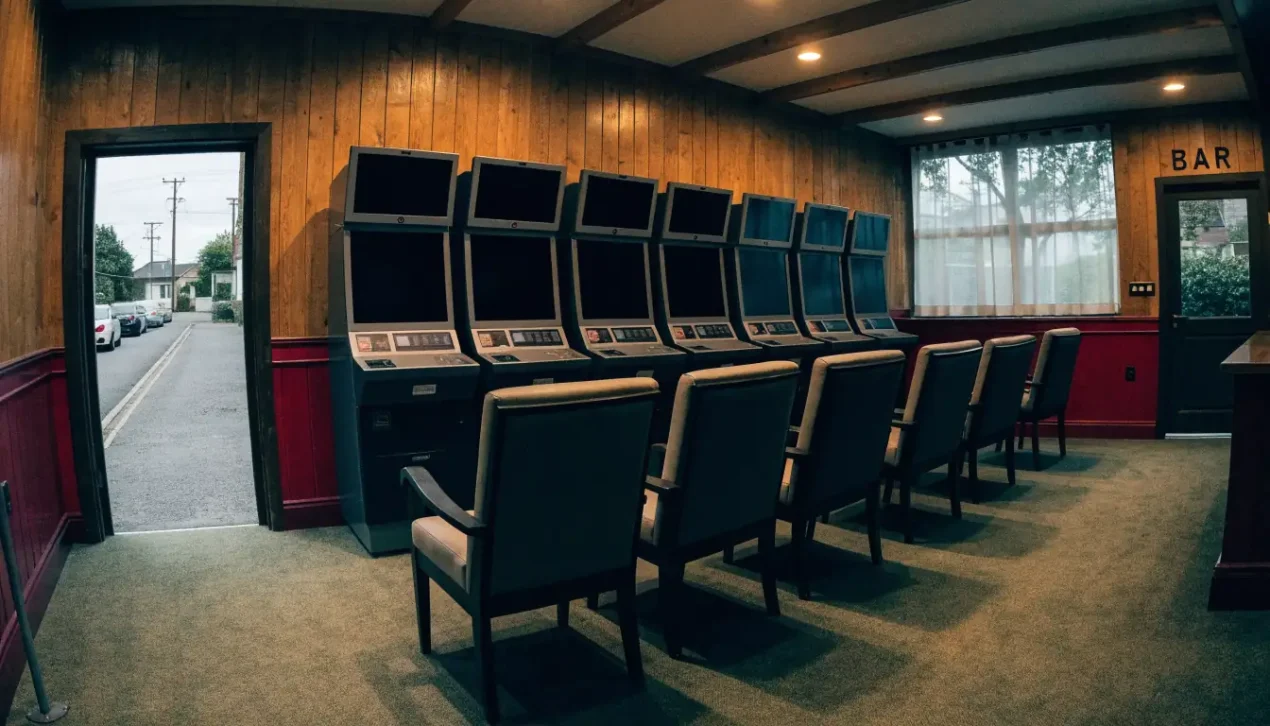
In a physical casino, a “parlour” suggests a designated room or area, not a separate kind of gambling service. The machines belong to the venue’s licensed environment: their presence is part of how the casino is authorised to operate, rather than evidence of a free-standing parlour with its own status.
That distinction matters because the familiar word pokies can make a large, regulated installation sound like an informal corner of the building. In practice, casino machine provision is counted through venue licensing and installation records. Across Australian casinos, the recorded total is 3,308 gaming machines endorsed on venue licences and installed on casino premises. The figure describes the scale of provision; it does not tell how machines are arranged, how often they are used, or what any individual venue feels like.
A room of machines is also a social design. It places solitary activity inside a shared public setting, where the quiet concentration of one person sits beside the circulation, noise and routines of a large venue. The word “parlour” can soften that institutional reality, turning a licensed gaming area into something that sounds domestic or intimate. The room may be contained; the system around it is not.
The label therefore works best as a description of setting. It points toward physical casino space and its machine provision, not toward a particular game or a promise about the experience. The count is substantial. The terminology is smaller than the thing it names.
Real-Money Claims and Australian Boundaries
“Real money” can make an online casino claim sound like an ordinary extension of a physical gaming venue. The wording does not change the legal distinction. In Australia, a casino’s physical gaming area operates under a licence from its state or territory; that does not authorise an online service to offer casino-style games to people in the country.
The Interactive Gambling Act 2001 prohibits operators from providing real-money online casino games to customers physically located in Australia. That includes online versions of casino games, whether a website describes itself as a parlour, a casino or something more polished. A label is not a local licence.
Real-Money Pokies on Android in Australia
Enforcement sits at the federal level. The Australian Communications and Media Authority monitors compliance with interactive-gambling laws and is responsible for enforcing the Act. Where a website provides prohibited gambling services or promotes them in Australia, ACMA can ask internet service providers to block access. That power marks a boundary; it does not turn a site’s marketing language into evidence of lawful local operation.
A page may still load, an account area may still appear, or a service may use a changing web address. None of those circumstances alters the rule governing what operators may offer to people in Australia. Nor does the phrase “real-money casino” describe a lawful Australian online casino service simply by asserting that one exists.
The difference is plain, if less marketable than the claim: physical casino gambling belongs to a state- or territory-licensed venue, while real-money online casino games offered to Australians are prohibited under federal law. The same word, “casino,” carries two different legal settings. A screen does not inherit a venue’s licence.
This material was created by the Goldenbet Notes team.
Related posts

Trusted Online Casinos in Australia: What Trust Means

Big Red Pokies Online in Australia: Free Play